The car that flew, and the brand that never needed to advertise
21/10/2026 | Uncommon Sense
By · 07/09/2026 · 4 min read
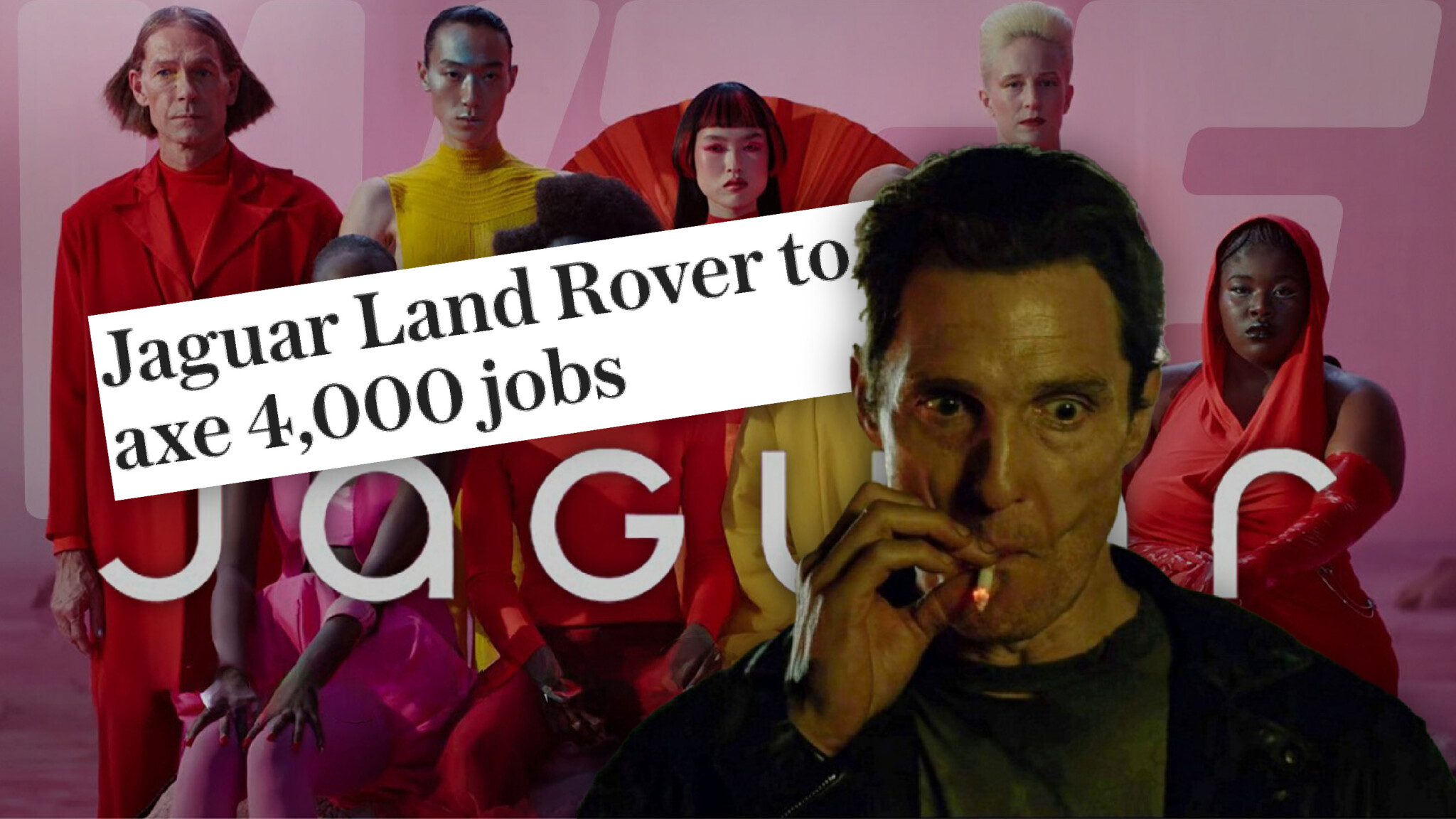
Jaguar Land Rover is cutting up to 4,000 jobs. The official causes arrived with the announcement, neatly ranked: Chinese competition, a cyberattack that halted production for weeks, American tariffs. All real. All, you will notice, somebody else’s fault. The list somehow omits the eighteen months during which the company chose not to sell any Jaguars at all.
Cast your mind back to November 2024. A car company launched a campaign containing no car. Androgynous models in primary colours strode across a Martian landscape beneath the slogan “Copy Nothing”, followed weeks later by a concept car in a shade the company called Miami Pink. Elon Musk asked the only question that mattered, in four words: “Do you sell cars?” Jaguar’s managing director, Rawdon Glover, responded by describing the critics as intolerant, and later explained that the point of the campaign was to get people asking what was going on at Jaguar. On that measure, total victory. Nobody in Britain was confused about there being something going on at Jaguar. It simply had nothing to do with buying one.
Because that campaign was never aimed at anyone with sixty grand and a driveway. It was aimed at the awards circuit, the trade press panels, the festival juries who hand out gold lions for bravery, and it worked flawlessly on the only audience it was built for: the shortlists came, the think pieces came, the conference invitations came. The people clapping do not buy Jaguars; they never did and never will. The people who did buy them, the dentists and directors and retired engineers who had kept the marque alive through decades of indifferent ownership, watched a company tell them in a two-minute film that everything they had loved about it was an embarrassment to be deleted.
Now, the defence. The industry’s answer to all this is that the rebrand did not cause the sales collapse, because Jaguar had deliberately stopped making cars to prepare for its electric relaunch. Fair enough; that’s true. But sit with what it means. A luxury company chose to have nothing to sell for a year and a half, in the most competitive luxury market in history, so that it could return as a £130,000 electric art object aimed at buyers it had never met. That is the decision. The advert was not the crime, it was the confession. And I’ll be honest about the arithmetic: Land Rover is the profit engine, and the Jaguar adventure is not the sole cause of 4,000 redundancies. It is the reason that when the tariffs hit and the hackers struck, there was no Jaguar business left to absorb any of it. No revenue, no cushion. A company that performs for insiders has nothing in reserve when reality comes to collect.
Two badges on one sign. For a year and a half, only one of them was selling anything.
What Jaguar’s marketers did to their customers, Whitehall is doing to British industry.
British manufacturers pay well over double the European average for their electricity, and the gap has widened since 2019, not narrowed. A senior Nissan executive told MPs this year that the Sunderland plant pays more for power than any Nissan factory anywhere in the world. And under the zero emission vehicle mandate, carmakers face fines of £15,000 per car for failing to sell enough electric vehicles to private buyers who, outside the fleet market, are choosing them roughly one time in ten.
This is a policy aimed at summits and at the moral comfort of the people drafting it, not at anyone who has to live with it, any more than Miami Pink was aimed at people with driveways. The applause happens in Westminster and at conferences abroad; the invoice arrives in Solihull, addressed to someone on the production line who never got a vote on any of it.
You can see the guilt in the response. When the redundancies were announced, the government immediately volunteered that it had cut manufacturers’ electricity bills, put billions behind electric vehicle production and launched a grant for electric car buyers. Nobody had asked. Ministers ruled out a bailout while reciting their own subsidies, which is a curious thing to do unprompted (a man who answers a charge that was never made has usually already convicted himself). Subsidising an industry to survive your own energy policy is restitution rather than support, paid in instalments with the receipts read aloud.
Nobody responsible will pay for any of this. The marketers have moved on to the next account, where the campaign will be described in pitch decks as brave. The ministers will be in another department by the time the targets bite, collecting credit for ambition while somebody else manages the consequences. Everybody who made the decisions is fine. Four thousand people who made and sold the cars are finding out. Because the two oldest facts in commerce have not changed and will not: the customer decides, and the electricity bill arrives. Neither of them has the slightest interest in what you think you stand for.
Jaguar is not the first brand to mistake applause for demand, and it will not be the last. Read more from Uncommon Sense on marketing that sells rather than marketing that wins prizes.