
Sydney Sweeney’s Latest Ad Worked. That’s Why People Are Angry.
15/09/2026 | Lee Taylor
By · 19/02/2026 · 4 min read
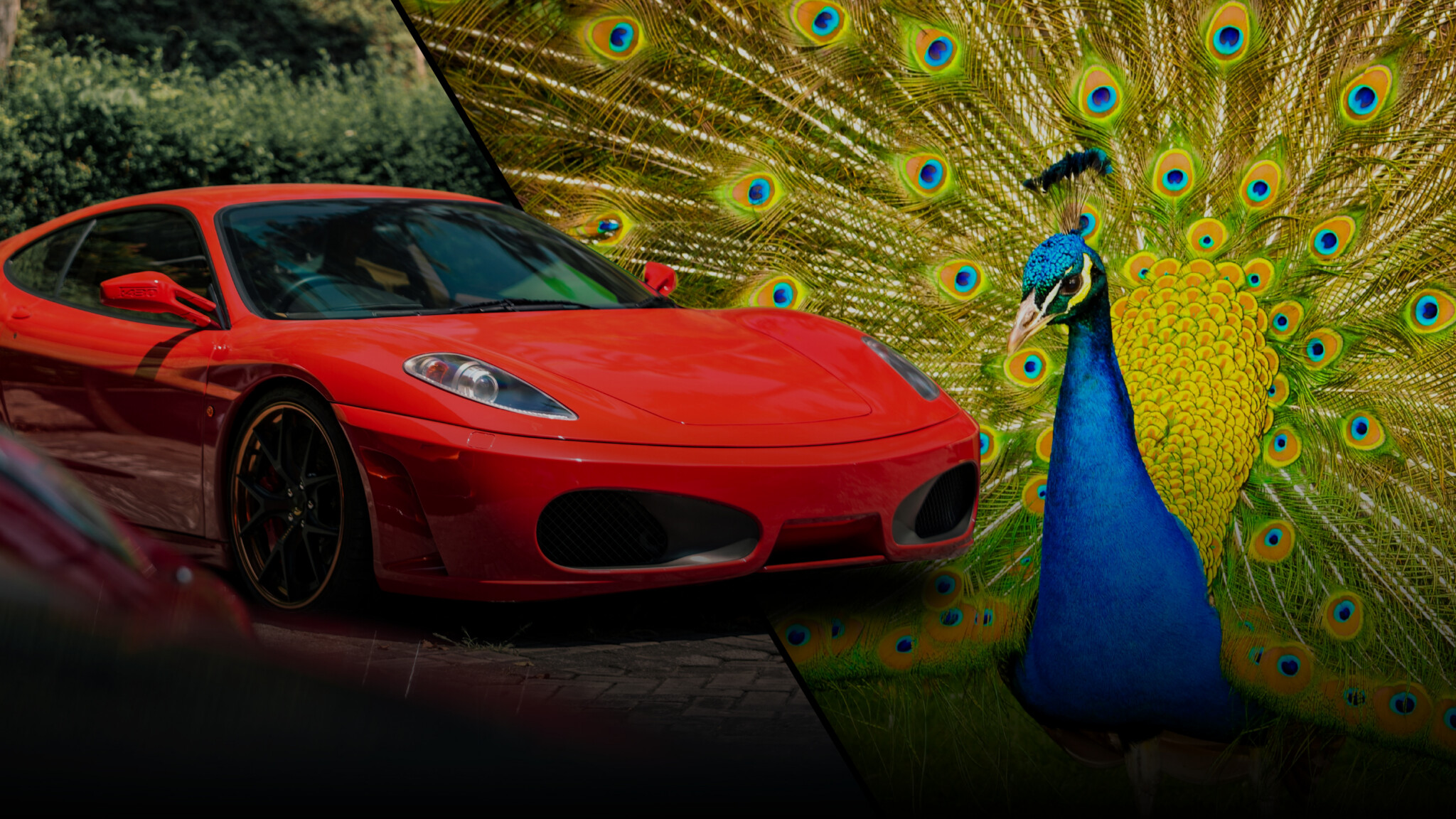
There is a reason the peacock evolved that tail.
It is heavy, impractical, metabolically expensive and makes him easier to spot by predators. From a narrow survival perspective, it is a liability. And yet it persists. Not because nature is irrational, but because survival is only half the evolutionary equation. The other half is reproduction.
Richard Dawkins, building on Darwin’s work in The Descent of Man, explains sexual selection as the process by which traits evolve not because they help you survive, but because they help you win mates. The male frigatebird inflates a bright red throat balloon that serves no hunting purpose whatsoever. The peacock drags around a decorative handicap. These traits are not decorative accidents. They are signals in a competitive mating marketplace.
That logic did not disappear when humans put on suits.
It simply moved into the showroom.
Evolutionary psychology extends this framework into modern consumer behaviour. What we call “conspicuous consumption” is, in many cases, a direct analogue of the peacock’s tail. Luxury goods function as costly signals. They are visible, expensive and often unnecessary. Their very inefficiency is the point. A sports car does not merely transport you; it advertises you.
The key evolutionary mechanisms help explain why this works. Ronald Fisher’s runaway selection model showed how preferences and traits can co-evolve in a feedback loop. If women prefer a particular display trait, and that preference is inherited, sons inherit the display and daughters inherit the attraction to it. Over generations, the trait exaggerates until balanced by survival costs. Amotz Zahavi’s handicap principle adds another layer: costly signals are honest signals. If a peacock can survive while burdened with a massive tail, he must possess underlying quality. Cost equals credibility.
Translate that into human markets and the logic becomes obvious. A Ferrari is not rational transportation. It is a handicap. It is expensive, inefficient and deliberately visible. It signals surplus resources. It signals status. It signals competitive success. It says, without saying, “I can afford this waste.”
Research backs this up. When men are primed with mating motives, thinking about dating, attractiveness or status competition, their interest in conspicuous luxury goods increases significantly. Not sensible cars. Not practical upgrades. Flashy, high-visibility products. Driving high-status vehicles has even been shown to elevate testosterone levels, mirroring dominance displays observed across species. Women, particularly in short-term mating contexts, rate men associated with luxury cars as more desirable and higher in mate value. Other men respond too, adjusting their perception of hierarchy and competitive threat.
None of this requires ideological interpretation. It is simply biology operating through culture.
From a marketing perspective, this matters enormously. Much of the modern advertising industry talks in the language of identity narratives, social constructs and abstract brand “purpose.” Yet underneath those layers, consumer behaviour is still shaped by ancient signalling mechanisms. Status, scarcity, dominance, belonging and mate value remain core psychological drivers. You can package a product in sustainability messaging or lifestyle storytelling, but if it fails to signal effectively within those deeper evolutionary frameworks, it will struggle to command premium positioning.
Luxury works because it is costly. Scarcity works because it signals exclusivity. Brand prestige works because it confers social rank. These are not cultural accidents; they are predictable outputs of a mating psychology shaped over hundreds of thousands of years.
The most successful advertisers, whether they articulate it in these terms or not, intuitively understand this. They do not merely sell function. They sell display. They understand that waste, when properly framed, becomes a feature rather than a flaw. The signal must be expensive enough to be credible. If anyone can fake it, it loses its power.
Of course, not all consumption is sexual signalling. Humans are complex. Women engage in signalling behaviours too, often in ways that reflect different mating strategies and intrasexual competition. Cultural norms mediate expression. Economic constraints shape access. But the evolutionary architecture remains constant. The mating market never disappears; it simply adapts to new mediums.
In a world of Instagram feeds and curated personal brands, the peacock’s tail has become digital as well as material. But the underlying game has not changed.
The uncomfortable reality for parts of the advertising industry is that biology still matters. Evolutionary consumer psychology does not reduce people to animals; it explains why certain messages reliably outperform others across time and geography. It clarifies why status cues convert, why exclusivity commands margin and why certain categories, cars, watches, fashion, and property function as social billboards rather than mere utilities.
If you ignore this, you end up building campaigns around abstractions that fail to move behaviour. If you understand it, you design persuasion around the instincts that actually drive purchase decisions.
From Galapagos sea lions competing for harems to city streets lined with Lamborghinis, the same evolutionary logic runs quietly in the background. Costly display signals quality. Quality attracts attention. Attention drives selection.
The tail now has wheels.
The game remains the same.
Want campaigns that work with these instincts instead of ignoring them? Get in touch.
