Victoria’s Secret: The Marketing Cost of Killing the Fantasy
16/10/2026 | Uncommon Sense
By · 17/10/2025 · 4 min read
From One Fantasy to Another
To fashionistas all over the globe, there has always been something special about the Victoria’s Secret Fashion Show. Traditionally held in the run-up to Christmas, its runway looks inspired endless wishlists, and for the fashion world, it once served as a debutante ball for the next generation of supermodels. The brand’s DNA – glamour, fantasy, and unapologetic sex appeal – was central to its worldwide allure.
I first started watching the Victoria’s Secret Fashion Show at fifteen, and my friends and I were captivated by the spectacle – the intricate styling, the live performances, and, above all, the unshakable confidence of its models. We each had our favourite Angel, of course, and we’d gossip about the show’s pop culture moments – like when Justin Bieber famously performed. Years later, when I finally had a disposable income, that sense of admiration naturally turned into loyalty; Victoria’s Secret became one of my favourite brands. By then, a new generation of Angels – Elsa Hosk, Taylor Hill, and Romee Strijd among them – had taken centre stage, and it felt as though the brand’s golden era was only just beginning.
However, as the progressive mist thickened across the West in the late 2010s, fashion giants came under immense pressure to cast a more diverse array of models – and Victoria’s Secret was no exception. The brand was effectively forced to cancel its famous fashion show in 2019 after then-Chief Marketing Officer Ed Razek stated he had no intention of including transgender or plus-size models, claiming the shows were designed to capture a “fantasy”. He later apologised, but ultimately resigned.
In the years that followed, Victoria’s Secret attempted to reinvent itself. It retired its iconic Angels in 2021 – once the faces of its most famous campaigns – and shifted toward new initiatives such as The Tour ’23, a digitally-focused showcase featuring transgender and plus-size models, athletes, and celebrities.
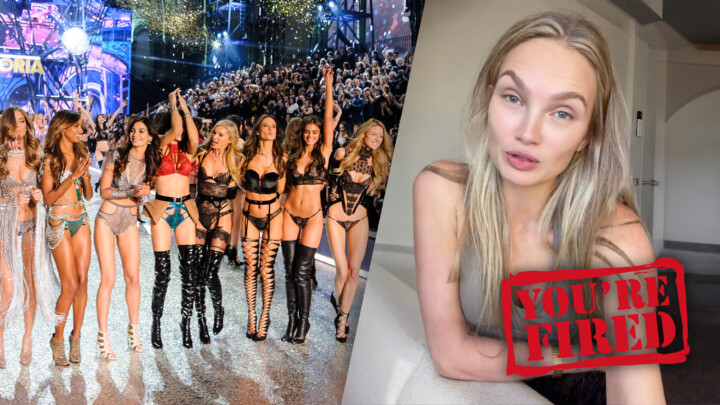
For the Angels themselves, the downfall was disheartening. Models who had spent years building their careers around the brand’s once-celebrated image suddenly found themselves dismissed as symbols of an outdated trend. Contracts were ended, photo campaigns disappeared, and the annual show that had propelled so many of their careers was gone overnight. The most ironic part? The women who once inspired millions – many having come from humble beginnings – were now being erased in the name of empowerment.
This strategic pivot also came at a significant cost. Many long-time consumers criticised the rebrand as performative and inauthentic, while the brand’s signature fantasy-driven image was destroyed. Financially, the results were stark: net sales fell from $7.5 billion in 2012 during its golden, pre-progressive era to $6.78 billion in 2021, and further to $6.18 billion by 2023. This devastating decline showed that abandoning the core elements that originally defined Victoria’s Secret’s aspirational brand disappointed loyal customers – without sufficiently attracting new ones.
Then, in 2024, its once-famous fashion show returned. Featuring some of the supermodels who previously stood as the brand’s Angels, such as Candice Swanepoel, and bringing back nostalgic elements like the dramatic feathered wings and elaborate runway staging, the twinkle was still sadly absent. It remained a far cry from the spectacle that graced our screens over ten years ago. Were the body types it featured broadly inclusive? No – but these models were called Angels for a reason. The show was designed to be a fantasy, showcasing women who trained like racehorses to strut down a long runway in wings that could weigh 20 – 30 pounds, all while posing perfectly for the camera.
So, when loyal customers awaited photos from this week’s show, many hoped to be pleasantly surprised – perhaps, this time, it would feel like 2010 again: no hollow virtue signaling, no hidden messages to ponder over, and maybe even a diamond encrusted Fantasy Bra would appear. And yes, while many of the old-era models reappeared, such as Doutzen Kroes and Grace Elizabeth – there was still overrepresentation; a tell-tale sign that diversity may be more performative than it should be.

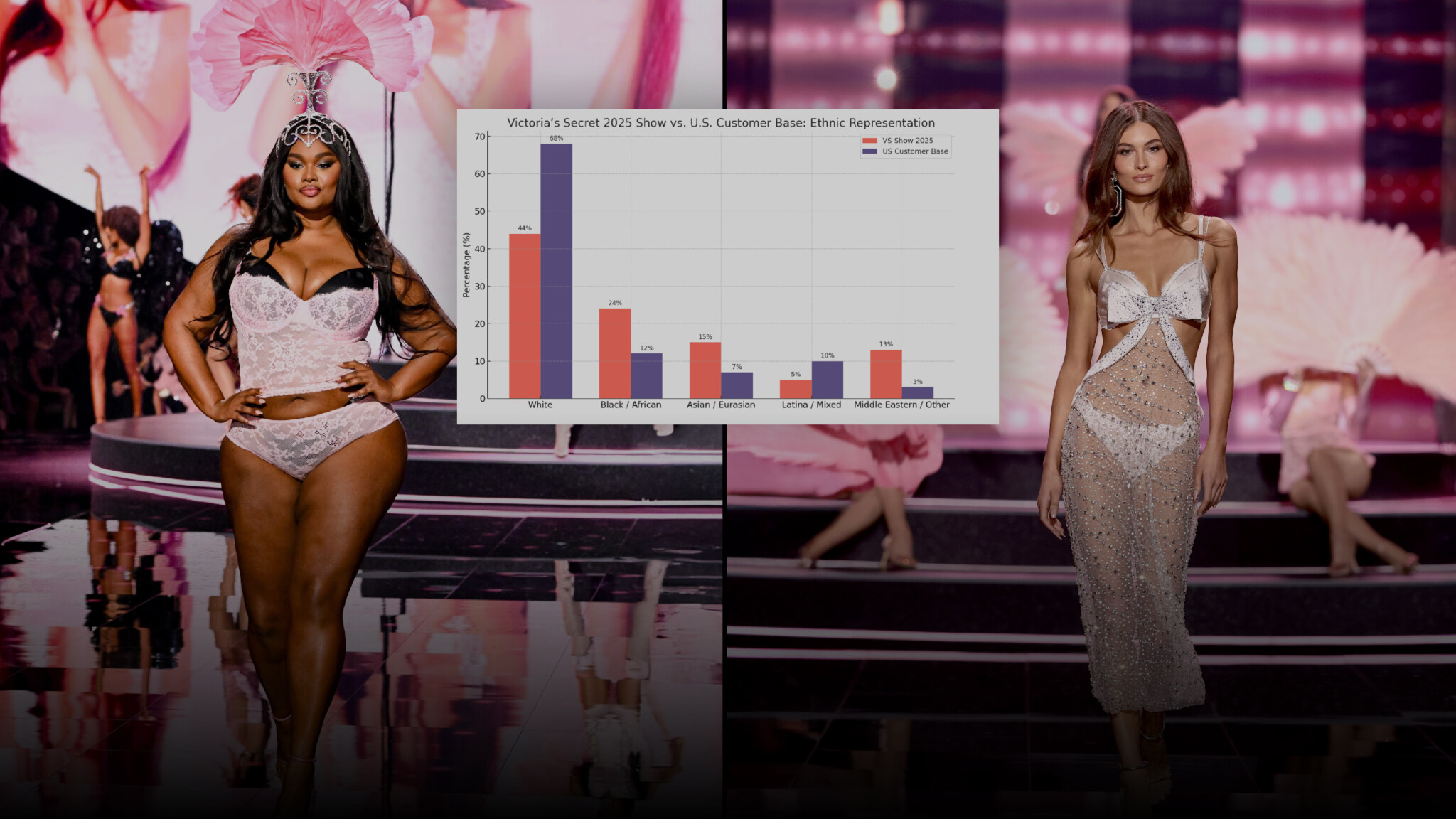
Please note: Percentages are approximate and based on publicly available demographic and casting data. Variations between sources may exist, but overall patterns remain consistent.
As I have argued in my other essays, if a brand is going to tinker with its fragile DNA to inject diversity, it should at least do so thoughtfully and authentically. Victoria’s Secret’s attempt, by contrast, has rightly been criticised as performative, as the graph above illustrates. Conventionally white and Latina customers were underrepresented, while Black and Asian models appear at roughly twice the proportion of their real-world customer base.
Victoria’s Secret’s journey over the past several years serves as a cautionary tale about the dangers of tampering with a brand’s core identity. In the late 2010s, a progressive mist drifted through the corridors of every major brand. But now, that mist is beginning to lift. Perhaps, at last, the twinkling “Angel era” can be released from its gilded cage of progressivism – and step once more into the light. After all, millions of loyal customers would celebrate such a return.